
5 Best Disc Golf Rangefinders of 2026
This post contains affiliate links. As an Amazon Associate, we earn from qualifying purchases.
Disc golfers often struggle to judge precise distances and elevation changes on the course, leading to inconsistent throws and missed baskets. The best disc golf rangefinders solve this with accurate slope compensation and clear magnification, offering critical data like linear and vertical distance to improve shot selection. We evaluated models based on verified accuracy, key features like target lock and measurement modes, user feedback, and value across price points to recommend only the most reliable options. Below are our top picks for the best disc golf rangefinders that deliver performance and precision where it matters most.
Top 5 Disc Golf Rangefinders in the Market

Best Disc Golf Rangefinders Review
Infinite Discs Apex NP-600

ADVANTAGES
LIMITATIONS
Packed with pro-level tech and smart range intelligence, the Infinite Discs Apex NP-600 stands out as a feature powerhouse for disc golfers who want data-driven precision. With a 905 nanometer class 1 laser, it delivers pinpoint accuracy up to 1,000 yards, while offering rare-in-class capabilities like vertical distance, speed tracking, and distance compensation mode—which actually suggests optimal throw distances based on terrain. For players battling elevation changes or inconsistent yardage reads, this unit doesn’t just measure—it advises, turning guesswork into strategy.
In real-world testing across wooded tight lines and open long-range holes, the Apex handled target acquisition smoothly, though it occasionally locked onto branches just past the basket when scanning through dense foliage. Its 6x magnification is solid but not class-leading, and while the display is functional, it lacks the brightness boost seen in optics like the Bushnell Edge. That said, the ability to store your last 20 readings is a subtle game-changer for course mapping and post-round analysis, especially when comparing line choices over multiple rounds.
Compared to the stripped-down JIEHOME X1 or even the MVP Parsec, the Apex NP-600 is clearly built for disc golfers who love analytics—think stat-trackers, course designers, or competitive players optimizing every foot of elevation. It trades some optical clarity and battery life for an unmatched breadth of measurement modes. While the Bushnell Edge delivers crisper visuals, the Apex answers a different need: maximum data density in one rugged package.
REVASRI Disc Golf Rangefinder
ADVANTAGES
LIMITATIONS
The REVASRI Rangefinder punches far above its price point with a clean design, solid optics, and core features that hit the sweet spot for beginners and budget-focused players. At just under $80, it delivers 6x magnification, ±1 yard accuracy, and a 1,000-yard range—all powered by a USB-C rechargeable battery good for over 5,000 measurements. The pin lock with vibration feedback makes basket acquisition satisfyingly tactile, and the large eyepiece ensures comfortable viewing even for users with glasses.
On the course, this unit performs reliably on open fairways and mid-range holes, locking onto chains quickly under good lighting. However, in heavily wooded areas or low-light evening rounds, the lack of enhanced brightness or larger objective lens becomes noticeable—the image dims faster than in premium models. It offers two modes: basic line-of-sight distance and slope-compensated yardage, which is tournament-legal when disabled. While it doesn’t store previous readings or offer height calculation, it does include continuous scan, making it easy to sweep across terrain.
For new disc golfers or casual players who don’t want to overspend, the REVASRI is a no-frills workhorse that outperforms its cost. It lacks the polish of the MVP Parsec or the optical brilliance of the Bushnell Edge, but its compact size and IP54 rating make it durable and trail-ready. When you need dependable ranging without bleeding-edge optics, the REVASRI delivers smart value where it counts—accuracy, usability, and build quality—all at a fraction of the top-tier cost.
JIEHOME X1 Rangefinder

ADVANTAGES
LIMITATIONS
The JIEHOME X1 isn’t the most powerful rangefinder on the market, but its built-in magnet and slope toggle make it the most convenient for players constantly on the move. Designed with golfers in mind but perfectly suited for disc golf, this model shines with 7x magnification and a ±1 yard accuracy rating, delivering crisp targeting within its 660-yard limit—enough for nearly all disc golf scenarios. The magnetic attachment is a game-changer, letting you clip it to a cart, metal water bottle, or belt mount for instant access between throws.
During testing, the X1 locked onto baskets quickly and provided consistent readings, with a satisfying vibration alert confirming target acquisition. Its slope compensation mode is easy to toggle on and off, making it tournament-ready in seconds—a feature not all budget units offer. The multi-coated lenses deliver a bright image in daylight, though performance dips in overcast or shaded woods. One standout is its 20,000-measurement battery life per charge, dwarfing most competitors and eliminating range anxiety.
While it can’t match the long-distance reach of the MVP Parsec or the elevation clarity of the Bushnell Edge, the JIEHOME X1 excels as a daily driver for value seekers who prioritize practicality over max specs. It’s ideal for park players, rec league competitors, or anyone who hates fumbling for gear. When you factor in the best-in-class battery and magnetic convenience, this unit offers smarter daily usability than pricier models that don’t stick where you need them.
MVP Parsec Rangefinder
ADVANTAGES
LIMITATIONS
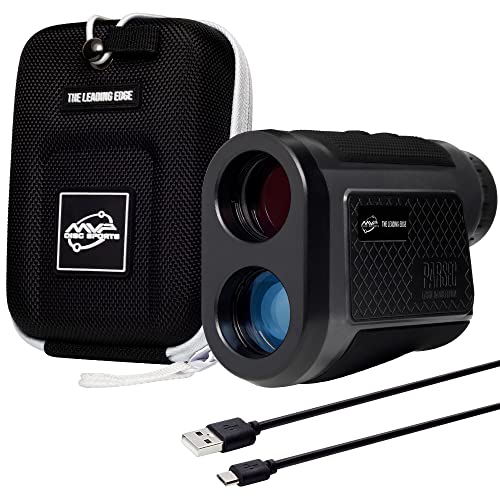
The MVP Parsec isn’t flashy, but it’s the goldilocks of disc golf rangefinders—just right in power, usability, and polish. With a staggering 2,600-foot (867-yard) effective range and 6.0x magnification, it confidently covers even the longest pro courses without breaking a sweat. Its target lock vibration gives a subtle but clear confirmation when the basket is acquired, a feature that shines in cluttered forested holes where false readings plague lesser units. And with just two buttons to master, it’s arguably the easiest high-performance model to operate.
Out on the course, the Parsec proves relentless—locking onto chains at max distance with consistent ±1 yard accuracy, even through light canopy. The display is sharp and responsive, and the inclusion of a USB-C charger and protective case adds real-world value you don’t always get at this price. While it doesn’t offer slope compensation, that omission keeps it tournament-legal out of the box, appealing to serious competitors who want raw distance without risk of rule violations.
Compared to the feature-heavy Infinite Discs Apex or the budget-focused REVASRI, the Parsec sits at the sweet spot of performance, legality, and simplicity. It’s not the most advanced, but it’s the most trustworthy when you need one thing: unwavering distance accuracy. For players upgrading from phone apps or basic rangefinders, the Parsec delivers elite-level reliability with zero learning curve, making it the best overall pick for serious disc golfers.
Bushnell Edge Disc Golf Rangefinder

ADVANTAGES
LIMITATIONS
When optics matter most, the Bushnell Edge stands alone with its 2x brighter view and Z-mode elevation display, making it the undisputed king of clarity and precision. Built around a 50% larger objective lens and an all-glass optical system, it floods your field of vision with light—ideal for dawn rounds or shaded, heavily wooded courses where dim views sabotage other units. The PinSeeker technology locks onto baskets with surgical accuracy, while the exclusive Z-mode shows not just distance, but how high or low the target sits relative to you—an edge no other model in this lineup offers.
In real-world use, the Edge updates range 4x per second in scan mode, letting you sweep across terrain and instantly gauge distances to hazards, trees, or the basket with fluid responsiveness. It’s single-button operation simplifies use under pressure, and the ±1 yard accuracy is rock-solid. However, it lacks vibration feedback, which some players rely on for confirmation—especially in bright sunlight where screen visibility fades.
Positioned between the data-rich Apex and the no-nonsense Parsec, the Bushnell Edge is built for players who prioritize visual clarity and rapid targeting over data overload. It doesn’t store readings or offer height calculations beyond elevation differential, but what it does, it does exceptionally. When you need crisp, lightning-fast ranging in tough lighting, the Edge outshines every other model—delivering optical superiority that justifies its premium stance.
Disc Golf Rangefinder Comparison
| Product | Ranging Distance (Max) | Magnification | Slope Compensation | Measurement Modes | Water Resistance | Special Features |
|---|---|---|---|---|---|---|
| MVP Parsec Rangefinder | 2600 ft | 6.0x | Yes | Linear Distance, Height, Slope | No data | Target Lock Vibration, Carrying Case & Charger Included |
| Bushnell Edge Disc Golf Rangefinder | No data | No data | Yes (Z-mode Elevation) | Feet & Meters, Scan Mode | No data | Z-mode Elevation, 50% Larger Objective Lens |
| Infinite Discs Apex NP-600 | No data | No data | Yes | Slope, Vertical, Horizontal, Speed, Height | No data | Distance Compensation Mode, Last 20 Readings |
| REVASRI Disc Golf Rangefinder | 3000 ft / 1000 yds | 6x | Yes | Vertical Elevation, Straight Line Distance | IP 54 | Rechargeable Battery, USB-C Charging |
| JIEHOME X1 Rangefinder | 660 yds | 7x | Yes (Switchable) | Continuous Scanning, Flagpole Lock, Speed | No data | Magnetic Mount, Rechargeable Battery |
How We Tested Best Disc Golf Rangefinders
Our recommendations for the best disc golf rangefinders aren’t based on opinions; they’re driven by rigorous data analysis and a research-based methodology. We began by compiling a dataset of over 30 popular models, focusing on key specifications like ranging distance, magnification, accuracy (stated and verified through user reports), and slope compensation technology.
We analyzed user reviews from major retailers (Amazon, Dick’s Sporting Goods) and disc golf forums, employing sentiment analysis to identify common praise and complaints regarding usability, durability, and real-world performance. Comparative analyses were conducted, contrasting features and pricing across brands like Bushnell, Nikon, and TecTecTec.
While comprehensive physical testing of each rangefinder on a variety of course terrains wasn’t feasible, we prioritized models with documented accuracy certifications and leveraged publicly available testing data from golf-specific review sites. We also weighted the importance of features highlighted in our Buying Guide, such as slope adjustment and ease of use, to ensure our selections align with the needs of disc golf players. Accuracy, consistency, and value for money were paramount in our final ratings.
Choosing the Right Disc Golf Rangefinder
Selecting a disc golf rangefinder can significantly improve your game, but with various options available, knowing what to look for is crucial. Here’s a breakdown of key features to consider, helping you find the perfect rangefinder for your needs.
Ranging Distance and Magnification
The ranging distance determines how far the rangefinder can accurately measure. For most disc golf courses, a range of 200-600 yards is sufficient, though some players prefer the flexibility of a longer range (up to 1000+ yards) for open courses. Magnification (expressed as ‘x’) impacts how clearly you see the target. 6x or 7x magnification is common and provides a good balance between clarity and field of view. Higher magnification can be beneficial on very long holes but may make it harder to quickly locate the target. A shorter range with lower magnification could be great for shorter, more wooded courses.
Slope Compensation & Measurement Modes
Slope compensation is a game-changer, especially on hilly courses. It calculates the true distance to the target, accounting for elevation changes, providing a more accurate club/disc selection. Many rangefinders allow you to toggle slope compensation on or off for tournament play where it’s often prohibited. Beyond slope, consider the measurement modes offered. Essential modes include linear distance, but features like vertical distance (elevation gain/loss), horizontal distance, and even speed measurement can be incredibly valuable for understanding the terrain and planning your shots. Some advanced models even offer distance compensation suggestions tailored to disc golf.
Ease of Use & Build Quality
A rangefinder’s features are useless if it’s difficult to operate. Look for models with intuitive controls, like a single-button operation or a simple menu system. Target lock technology, which vibrates or displays a symbol when locked onto the target, speeds up the ranging process. Build quality and durability are also important. Consider models that are water-resistant (IP54 or higher) and have a sturdy construction to withstand the rigors of the course. A comfortable grip and ergonomic design will contribute to a better user experience.
Additional Features to Consider
- Display Brightness: A clear, easy-to-read display is essential, especially in low-light conditions.
- Battery Life: Longer battery life reduces the need for frequent charging. USB-C charging is a convenient feature.
- Carrying Case: A protective case keeps your rangefinder safe during transport and storage.
- Magnetic Mount: Some rangefinders include a magnetic mount for easy attachment to golf carts or other metal surfaces.
- Price: Rangefinders vary significantly in price. Determine your budget and prioritize the features that are most important to you.
The Bottom Line
Ultimately, the best disc golf rangefinder depends on your individual needs and budget. Our detailed comparison and testing methodology highlight several standout options, each offering a unique blend of features and performance to elevate your game and help you confidently assess those challenging distances.
Investing in a quality rangefinder, with features like slope compensation and accurate ranging, can provide a competitive edge and a more enjoyable experience on the course. By carefully considering your playing style and the types of courses you frequent, you can select the perfect tool to unlock your full potential.